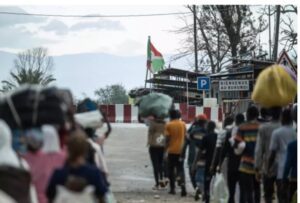
In a stunning political development, former President Joseph Kabila Kabange has returned to the Democratic Republic of Congo after a year in exile—making his way through Kigali, Rwanda, before arriving in the conflict-ridden eastern city of Goma.
The move, confirmed on Friday, April 18, sends ripples across the region as tensions between the Congolese government and the M23 rebel group continue to escalate. Kabila’s return is not only symbolic—it’s strategic, potentially signaling a new chapter in the political and military equation of the DRC.
From Power to Exile: Kabila’s Silent Year in Harare
Joseph Kabila ruled the DRC from 2001 to 2019, stepping in after the assassination of his father, Laurent-Désiré Kabila. He presided over a tumultuous era, navigating wars, elections, and fragile peace deals, before handing over power to Félix Antoine Tshisekedi Tshilombo.
However, despite stepping down, Kabila remained a towering figure in Congolese politics. After a series of political rifts with Tshisekedi’s administration and increasing instability in eastern Congo, Kabila quietly left the country in early 2024, taking refuge in Harare, Zimbabwe.
His silence was deafening—until Tuesday, April 8, when he unexpectedly announced plans to return.
“The country is facing a serious crisis—insecurity, economic hardship, and a lack of direction. I cannot remain indifferent,” Kabila declared in a rare public statement. “I am coming back to help seek solutions.”
Kabila Enters Through Kigali, Arrives in a City Held by Rebels
What raises eyebrows is not just Kabila’s return, but how and where he re-entered.
Rather than returning through Kinshasa or another government-controlled zone, he flew into Kigali, the Rwandan capital—a move full of political implications—before crossing into eastern Congo and landing in Goma, a city currently under the control of M23 rebels since late January.
This route—through Rwanda—carries symbolic and strategic weight, considering Rwanda’s alleged support for the M23, accusations that Kigali strongly denies.
Alliance in the Shadows? The AFC Connection
Reports suggest that Kabila’s return may not be a solo act.
Sources indicate that he may be aligning with the Alliance Fleuve Congo (AFC), a political-military coalition that includes M23 as a major component. The AFC is led by Corneille Nangaa, the former head of the DRC’s Independent Electoral Commission during Kabila’s rule.
“AFC is not just a rebel front—it’s a political movement seeking structural change in the country,” Nangaa said in a recent interview. “If Kabila joins us, it’s because he understands the stakes.”
Kabila vs Tshisekedi: A Long-Running Cold War
The return occurs in the midst of a deepening feud between Kabila and President Tshisekedi. For years, Tshisekedi has accused Kabila of being the “main financier” of M23—a charge that has yet to be proven but continues to strain their already frosty relationship.
With the presidential elections in the rearview mirror and Congo’s east spiraling into chaos, Kabila’s arrival in M23-held territory looks less like a homecoming—and more like a calculated maneuver.
A Nation Watches: What Comes Next?
Kabila is expected to address the Congolese nation on Saturday, speaking from Goma, the de facto capital of North Kivu Province. His speech could be a defining moment—not just for him, but for the future of the DRC.
As speculation swirls about his true intentions—reconciliation, resistance, or perhaps a return to power—one thing is certain: Joseph Kabila is back, and the balance of power in the DRC may never be the same again.
🚀 First to Know – Join Our WhatsApp!