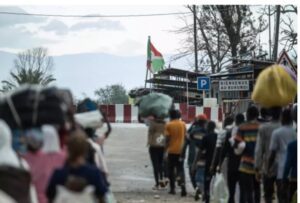
A Withdrawal That Signals More Than a Military Move
When the Alliance Fleuve Congo (AFC/M23) announced on 15 November 2025 that it would withdraw its forces from the strategic city of Uvira, the decision immediately sent ripples across diplomatic, military, and political circles in the Great Lakes region. The announcement was brief, formal, and carefully worded—but behind it lay weeks of intense diplomatic pressure, particularly from the United States, and a fragile peace process struggling to gain credibility.
Uvira is not just another city in eastern Democratic Republic of the Congo (DRC). It is a gateway city, a border hub on Lake Tanganyika, and a symbol of control in South Kivu. For AFC/M23 to step back from it is not insignificant. And according to the movement itself, the withdrawal was carried out “as per United States mediation’s request.”
That single line, buried in the official communiqué, reveals the true weight of the decision.
U.S. Mediation and the Doha Process: Pressure Behind the Scenes
The withdrawal comes within the framework of the Doha Peace Process, which culminated in the signing of the Doha Framework Agreement on 15 November 2025. Unlike previous regional initiatives, the Doha talks have been marked by stronger involvement from international actors, with the United States playing a central mediating role.
In its statement, AFC/M23 explicitly linked its decision to this process:
“The Alliance Fleuve Congo (AFC/M23) wishes to refer to the Doha Peace Process under which significant progress was recently achieved, including the signing of the Doha Framework Agreement of November 15th 2025.”
However, progress did not come without pressure. Regional reporting, including by Umuseke, makes clear that American diplomats pushed for a concrete, visible de-escalation step—and Uvira was chosen as the test case.
The logic was simple: if negotiations were to be taken seriously, words had to be matched by actions on the ground.
Why Uvira? A City at the Heart of the Conflict
Uvira sits at the crossroads of security, politics, and regional relations. Its proximity to Burundi, its access to Lake Tanganyika, and its dense civilian population make it both strategically valuable and dangerously volatile.
For U.S. mediators, removing armed forces from such a city would:
Reduce the risk of urban warfare
Lower civilian exposure to violence
Signal seriousness from AFC/M23
Create momentum for further concessions
For AFC/M23, however, withdrawing from Uvira meant accepting a politically costly demand—one that could weaken its leverage if the process collapses.
That is why the movement framed the withdrawal as both compliance and caution.
“Despite Provocations”: AFC/M23’s Calculated Compliance
In its communiqué, AFC/M23 emphasized that the withdrawal was not carried out from a position of weakness, but rather under diplomatic constraint:
“In light of these achievements, and despite the continued provocations and abuses from the FARDC and its allies, the Alliance Fleuve Congo (AFC/M23) initiate a unilateral trust-building measure.”
The phrase “despite the continued provocations” is not incidental. It reflects the movement’s effort to reassure its supporters and fighters that the withdrawal was politically imposed, not militarily forced.
More tellingly, the statement makes the U.S. role explicit:
“AFC/M23 will unilaterally withdraw its forces from the city of Uvira as per United States mediation’s request.”
This acknowledgment underscores the direct influence of American diplomacy, transforming the withdrawal into a visible outcome of U.S. pressure rather than a purely voluntary gesture.
Lessons from the Past: Why AFC/M23 Is Wary
The communiqué then shifts tone, moving from compliance to warning. AFC/M23 draws heavily on past experiences where similar withdrawals, according to the group, led to retaliation and violence against civilians.
“Based on past experiences where FARDC, Wazalendo and their allies have sought to take advantage of AFC/M23’s trust-building measures to retake control of previously lost territory and target the population perceived as sympathetic to the Alliance…”
This reference is critical. It explains why AFC/M23 insists that the withdrawal must be accompanied by international safeguards, not merely diplomatic promises.
Demands Placed on Guarantors: Turning Pressure into Protection
AFC/M23 places the burden of success squarely on the shoulders of peace guarantors, implicitly including the United States. The communiqué calls for:
“…adequate measures for the management of the city, including its demilitarization, the protection of its population and infrastructure, and the monitoring of the ceasefire through the deployment of a neutral force.”
Here, diplomatic pressure reaches its limit. Withdrawal alone does not guarantee peace. Without enforcement, the move could create a security vacuum, exposing civilians to revenge attacks and destabilizing the process further.
This section transforms the article’s narrative: U.S. mediation pressure achieved compliance, but responsibility now shifts to implementation.
Regional Stakes: Burundi and the Question of Cross-Border Stability
In a striking addition, AFC/M23 also addressed the issue of armed groups hostile to the Government of Burundi, signaling awareness of broader regional concerns—many of which align closely with U.S. strategic interests.
“The AFC/M23 reiterates that it will not allow such groups to use liberated areas as rear bases for any hostile acts likely to undermine good-neighborly relations between our two countries.”
This commitment serves multiple purposes:
Reassuring Burundi
Appeasing international mediators
Positioning AFC/M23 as a responsible regional actor
It also shows that U.S. mediation is not focused solely on Congo, but on preventing wider regional destabilization.
Public Messaging and Corneille Nangaa’s Role
The statement was publicly disseminated by Corneille Nangaa, AFC Coordinator, through his official X (formerly Twitter) account. By publishing the communiqué openly, AFC/M23 ensured that the withdrawal—and the U.S. role behind it—was visible to diplomats, analysts, and the international media.
This communication strategy reflects a shift:
From battlefield messaging to political signaling
From secrecy to controlled transparency
From regional conflict to international scrutiny
The withdrawal was not just carried out—it was staged for diplomatic audiences.
Can U.S. Pressure Deliver Lasting Peace?
The withdrawal from Uvira is now a test case—not only for AFC/M23, but for U.S. mediation itself. Diplomatic pressure succeeded in extracting a concession, but the harder task lies ahead: ensuring security, preventing reprisals, and keeping negotiations alive.
If Uvira descends into violence, the credibility of the Doha process—and of U.S. diplomacy—will suffer. If stability holds, the withdrawal could become a template for further de-escalation.
Conclusion: A Turning Point Forged by Diplomacy
AFC/M23’s decision to withdraw from Uvira was not made in a vacuum. It was the product of U.S.-led mediation pressure, calculated compliance, and a fragile peace process seeking momentum.
As the communiqué itself makes clear, this is not the end of the conflict—but it may be the first moment in years where diplomacy visibly reshaped realities on the ground.
Whether this moment leads to peace or another cycle of betrayal now depends on what happens next—after the cameras fade and the diplomats move on.
🚀 First to Know – Join Our WhatsApp!